
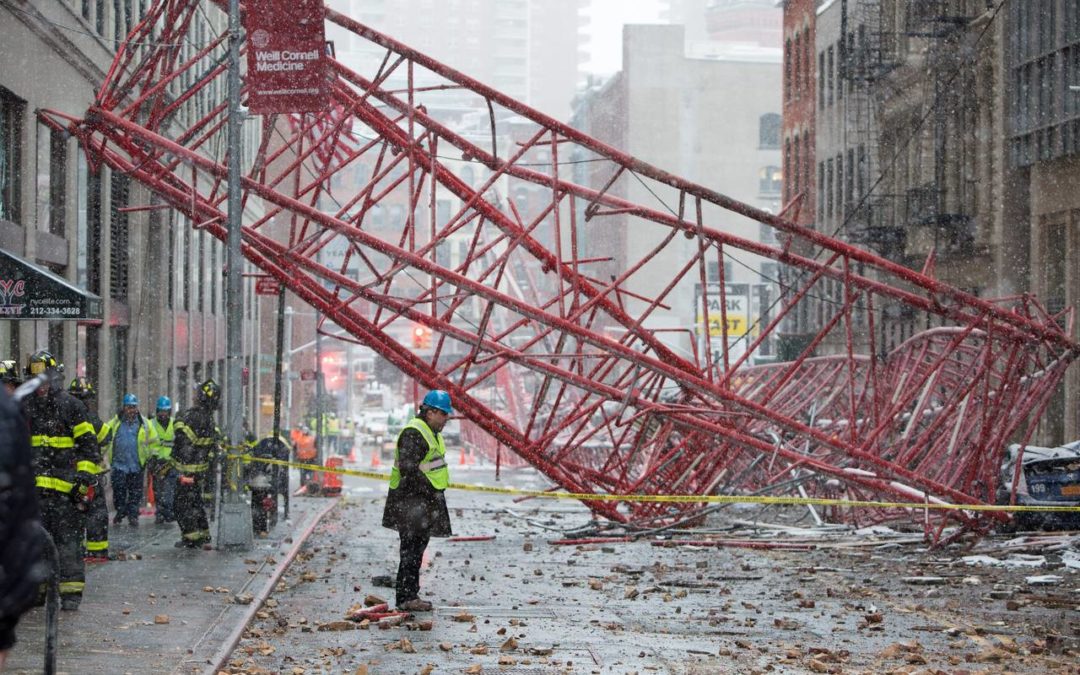
Fatal Tribeca collapse triggered proposal for new data-logging gear; ‘It is a sensible thing’
The WSJ.com reports four months after a construction crane collapsed on a Manhattan Street in high winds, killing a pedestrian, a city panel has recommended cranes be equipped with black boxlike devices to electronically capture crane activity.
It was one of a number of sweeping mandates proposed Friday by a technical working group convened by the city after the 500-foot crane tumbled to the ground Feb. 5 in Tribeca, crushing cars and injuring three other people.
The report also called for a requirement that most cranes operating in the city be equipped with devices known as anemometers capable of measuring a wind gust lasting only three seconds.
Following two 2008 fatal crane accidents, a city report recommended that the city study the use of black boxes as part of much larger review of high-risk construction oversight, but so far the city hadn’t made it a requirement.
“It is a sensible thing and the time has come” said buildings Commissioner Rick Chandler. “If we claim to have the most stringent crane regulations in the country, which we firmly believe, this is the next step.”
Mayor Bill de Blasio said the city Department of Buildings would review the proposals and implement the ones it can on its own and work with the City Council on others.
The report also called for an aircraft-style checklist for the inspection of each crane before operations begin each day. A new worksite position, to be known as a “lift director,” would oversee all aspects of crane safety.
Some of the proposals reflect recent national standards for crane use while others, such as the data-logging black boxes, are innovations that have been installed in many cranes in recent years.
The data recorded by the black boxes would include the crane’s configuration, how far out the load is, switch settings and when the operator overrides automatic settings. The report says data must be made available to the Department of Buildings at the agency’s discretion.
The cause of the February crane collapse hasn’t been determined, but one city official noted crane did have a black box, which has become part of the investigation.
Some cranes in use in New York City include wind information in their time-stamped black boxes, which others track the wind separately, crane operators say.
After the February accident, the city banned all cranes that weren’t designed to operate with winds above 20 miles an hour. When winds were forecast to reach 30 miles an hour the city issued “cease-operations” orders directing cranes to be shut down.
This led to complaints from contractors and developers that cranes were shut down even when little wind was detected.
The report recommend the city drop this practice, except in extreme weathers. Instead, contractors at large job sites would be required to hire meteorologists to determine “pin point forecasts” that take into account the local topography of a building and its exposure to the wind.
“It will give you a more accurate forecast,” said Louis Coletti, president of the Building Trades Employers’ Association, which represents many New York area contractors. “In one day, 58 tower cranes were shut down. Wind conditions are different street by street and site by site.”
Mr. Coletti said the industry was a partner with the city in improving public safety but wanted to have “a continuing dialogue” on how the new rules would be implemented.
John Banks, president of the Real Estate Board of New York, said the proposals were “a meaningful step forward toward fundamental reform.”
The five-member working group included the deans of engineering schools at Columbia University and New York University. Its members weren’t directly involved in the high-rise construction business in New York, city official said.
One member, Peter J. Madonia, chief operating officer of the Rockefeller Foundation, said the panel tried to put in a more systematic use of technology to “get ahead of curve.”
“We are a complex city and those are big machines,” he said. “I don’t think there is over regulation. It is complicated because New York’s infrastructure and its grid are complicated.”
The task force also urged the city to explore new kinds of cranes, including self-erecting tower cranes increasing used in Europe. These can be driven to a site, unfolded and set up in less than an hour and are suitable for low to mid-rise buildings. The report said they had a small foot print and could operate in tight areas “while ensuring safe operation.”
By JOSH BARBANEL


