
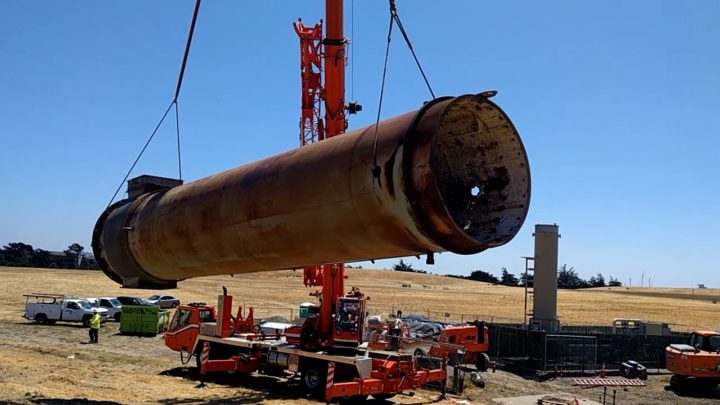
The old flare station at Berkeley, CA Cesar Chavez Park, is gone. A crew from Innovative Construction Solutions (ICS), aided by Hatton Crane Service, under the watchful eyes of Taylor Lancelot of the City of Berkeley and a representative from SCS Engineers, who built the system originally, took down the rusty leaning tower in a seven-hour session on Tuesday, Aug. 9, under bright skies with a modest westerly breeze.
Cesar Chavez Park is a green cover over what was, until 1983, the Berkeley city dump. Compostable refuse generates methane and other landfill gases. In the 1980s, a group of scientists and environmentalists argued that a flare station was unnecessary at this site. Measurements showed that surface emissions of methane were below levels of concern, probably due to the action of soil bacteria that “eat” methane. This inexpensive natural bioremediation process was sufficient, they argued.
But the Bay Area Air Quality Management District (BAAQMD) brushed aside the measurements, branded bioremediation as “experimental,” and threatened the city with heavy fines unless it installed a mechanical gas extraction and flare system. The city complied.
Flare stations are basically incinerators that convert methane, a highly harmful greenhouse gas, into carbon dioxide, also a greenhouse gas but much less harmful to the atmosphere than methane.
The new flare station, which is now operational, is more modern, more efficient and a lot prettier to look at, but its main qualification for the job is that it’s much smaller and can run on less gas.And so the flare station is dead, but long live the new flare station. It cost $721,000 to install and will cost an additional $150,000 a year to maintain, for as long as it remains operational.
Two questions remain: how long will there be enough gas to drive the new device? And how long before gas levels drop below BAAQMD’s benchmark?


