
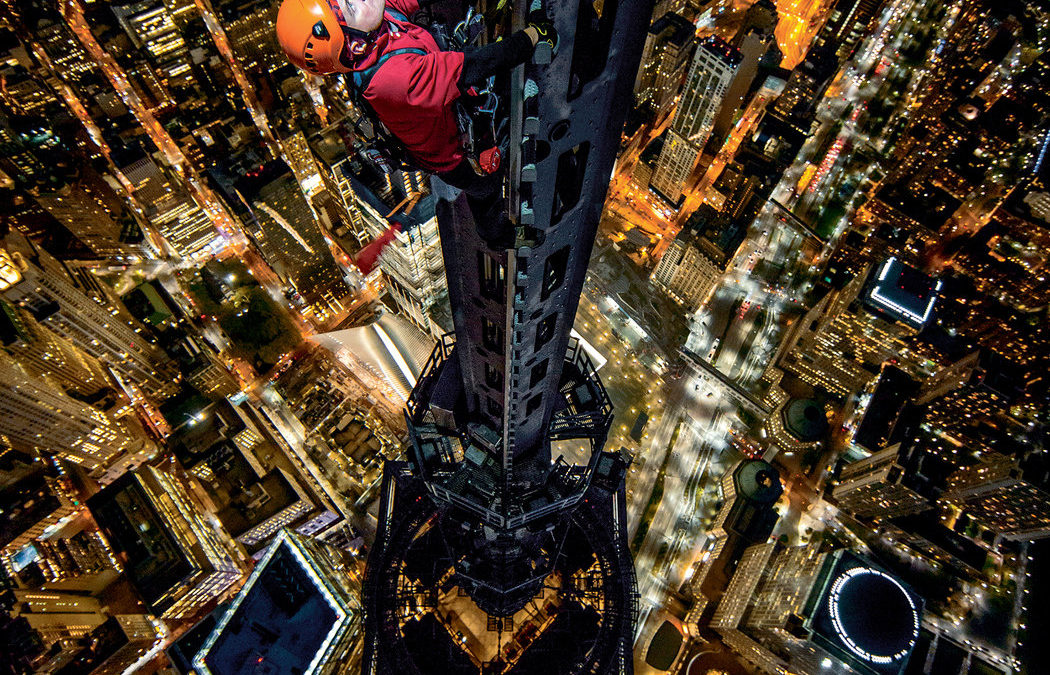
The New York Issue reports a city on an island, teeming with cash and ego, has nowhere to go but up. And up. And up. Imagine the Manhattan skyline in a time-lapse filmstrip, starting around 1890 — when the New York World Building crested above the 284-foot spire of Trinity Church — and culminating in the present day: it is a series of continual skyward propulsions, each new proud round overshadowing the last.
TAKE THE AMAZING 43 PICTURE TOUR HERE

Perhaps much of this history has been driven by crude competition — the fierce battle between the Chrysler Building and the Bank of Manhattan Trust Building (40 Wall Street), for instance, to be the World’s Tallest Building, a fight the Chrysler won by a stunning coup de grâce: the last-minute addition of its secretly constructed spire, which nudged New York’s altitude record up to 1,046 feet for 11 precious months until the Empire State Building topped out. But the city’s architectural history cannot be reduced to gamesmanship. Something else is going on. Manhattan builds up because it cannot build out and because it cannot sit still. Those of its inhabitants who can afford to do so will seek to climb to higher ground.
We are currently in the midst of another clambering epoch. The city has 21 buildings with roof heights above 800 feet; seven of them have been completed in the past 15 years (and three of those the past 36 months). In this special New York Issue, we explore the high-altitude archipelago that spreads among the top floors of these 21 giants. It totals about 34 million square feet in all, encompassing lavish living spaces, vertiginous work environments (during construction and after), elite gathering places. Visually, the experience of this new altitude feels different in kind from its predecessors, the peak uplifts of previous booms that topped out at 400, 500 or 600 feet. At 800 and above, you feel something unusual in a city defined by the smelly bustle of its sidewalks and the jammed waiting and inching and zooming of its avenues — a kind of Alpine loneliness. Every New Yorker knows the pleasant private solitude that can be found at street level, among anonymous crowds. This is something different: an austere sense of apartness inspired by achieving a perspective seemingly not meant for human eyes.
In 10 years, the views captured in the following pages might seem quaint, even inferior. But today they provide an uncommon glimpse into the city’s rarefied new neighborhood in the sky.
Jake Silverstein is editor in chief of the magazine.

Jamison Walsh on the spire of 1 World Trade Center. Jimmy Chin for The New York Times


