
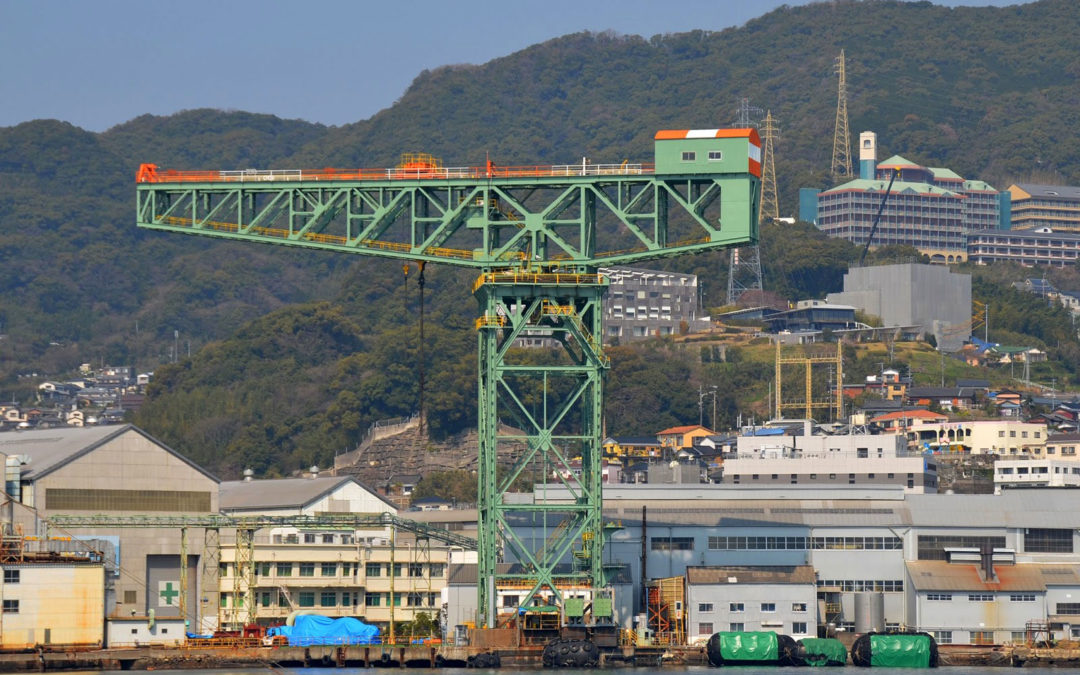
The Giant Cantilever Crane at the Mitsubishi Heavy Industries shipyard in the Port of Nagasaki is a major landmark in a city with strong historical links to Scotland.
The Scottish-designed-and-built Nagasaki Giant Cantilever Crane in Japan will be the final international site for the ground-breaking Scottish Ten laser scanning and digital documentation project.
The iconic crane, which was built in 1909, is still regularly used today by the Mitsubishi group, and is a major landmark within Nagasaki Harbor. The crane was ordered on the advice of Fraserburgh-born Thomas Blake Glover, who is regarded as a key figure in the industrialization of Japan in the late 19th and early 20th Centuries. It was designed by the Glasgow Electric Crane and Hoist Company – which was operating under the name of Appleby. It was constructed by the Motherwell Bridge Company and sits in the heart of Nagasaki Harbor – the birthplace of Mitsubishi Heavy Industries. Giant Cantilever Cranes were state-of-the-art structures designed to lift, with the utmost accuracy, the heaviest and most valuable components into the hulls of ships under construction, being re-fitted or undergoing repair.

Now the crane, which is only one of 11 of its kind known to survive, including the ‘Titan’ Crane in Clydebank, is to be laser scanned by the Scottish Ten using some of the latest digital recording equipment. A team from Scotland will visit Nagasaki later this year to record every part of the structure, to an accuracy of 6 millimetres. The information gathered by the team will be used to aid the conservation and management of the structure as well as acting as a valuable education and interpretation resource for the crane’s owners. The data will also be used to enable ‘virtual access’ to the crane, making up for the fact that public access is not possible because of its live function as an operating structure.
The crane was considered to be of sufficient international importance to be included in the ‘Sites of Japan’s Meiji Industrial Revolution’ World Heritage nomination, submitted by Japan in January 2014, for consideration by UNESCO’s World Heritage Committee in 2015.


