
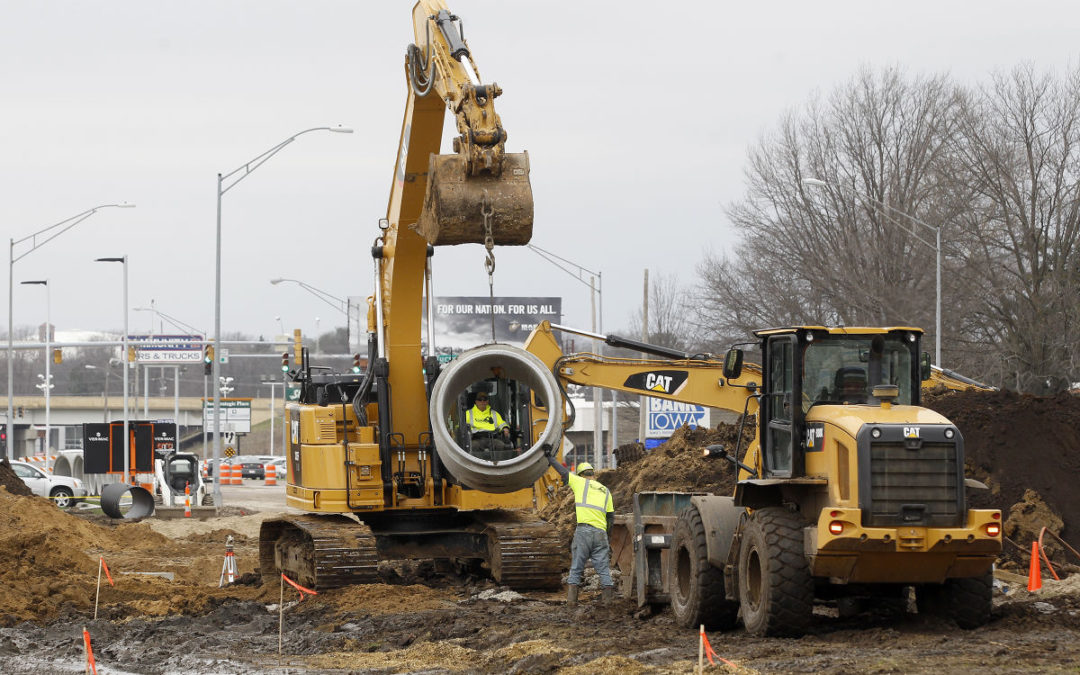
WATERLOO, Iowa — Construction employment increased in 244 out of 358 metro areas, was unchanged in 44 and declined in 70 between March 2015 and March 2016, according to a new analysis of federal employment data released Wednesday by the Associated General Contractors of America.
Iowa went from 69,300 to 76,100 construction jobs, or a 10 percent gain, from March 2015 to March 2016, the study showed.
The Waterloo-Cedar Falls area was not included in the study, but Bradley Best, president of Waterloo-based Peters Construction Corp., said the findings likely match up well with what’s happening in the local market.
“I think that’s a fair assessment of what’s happening in the Cedar Valley,” Best said. “We’ve added onto our workforce, as well, over the last six months. We’re always looking for good people.”
The trend should continue over the upcoming summer season, Best said.
“I think this market has a lot of projects that are underway and still more in the planning stages,” he said. “Items such as Cedar Falls bond issue only help that cause. The immediate future looks pretty bright.”
Association officials said the new figures show that the construction sector, in most parts of the country, continues to recover from a years-long downturn.
“With more than two-thirds of the nation’s metro areas adding construction jobs it is clear that the demand for construction is broad-based geographically and by project type,” Ken Simonson, the association’s chief economist, said in a news release. He noted that construction employment hit new peak levels in 31 metro areas.
“The main soft patch for the construction industry remains the parts of the country most likely to be affected by declining energy prices.”
Anaheim-Santa Ana-Irvine, Calif. added the most construction jobs during the past year (11,900 jobs, 14 percent). Other metro areas adding a large number of construction jobs include New York (9,000 jobs, 7 percent); Atlanta-Sandy Springs-Roswell, Ga. (8,500 jobs, 8 percent); and Orlando-Kissimmee-Sanford, Fla. (8,300 jobs, 14 percent). The largest percentage gains occurred in El Centro, Calif. (45 percent, 1,000 jobs); Monroe, Mich. (36 percent, 800 jobs) and Haverhill-Newburyport-Amesbury Town, Mass.-N.H. (28 percent, 1,000 jobs).
The largest job losses from March 2015 to March 2016 were in Odessa, Texas (-2,700 jobs, -14 percent), followed by Fort Worth-Arlington, Texas (-2,600 jobs, -4 percent); Cleveland-Elyria, Ohio (-2,500 jobs, -8 percent) and Midland, Texas (-2,200 jobs, -8 percent). The largest percentage declines for the past year were in Bloomington, Ill. (-15 percent, -400 jobs); Odessa; Grants Pass, Ore. (-13 percent, -100 jobs); Decatur, Ill. (-13 percent, -400 jobs) and Laredo, Texas (-13 percent, -600 jobs).
Association officials said the new employment figures are encouraging, but cautioned that workforce shortages are likely to grow as the industry continues to expand. They noted that 70 percent of firms, according to the association’s annual Outlook survey, report they are already having a hard time finding qualified workers.
Those shortages will only get more severe considering the lack of secondary-level programs to recruit and prepare future construction workers, they added.
“As firms add to their backlog of pending projects, the backlog of available workers continues to shrink,” said Stephen Sandherr, the association’s CEO. “It is time to start sending signals to students that there are multiple paths to success in life, and while college and office jobs are one path, high-paying careers in construction offer another, equally viable option.”


